10 May 2009

What were you doing to make that discovery?

This story is going to fall into the category summarised by the old adage – what did the first person who got milk out of a cow actually think they were doing? In other words; what on earth were you up to to make that discovery?

My husband is a terrible snorer – actually, that’s not true; he’s very good at it. He’s loud, rumbustious and it’s very distracting. When he snores, I certainly can’t sleep and the resulting quality of his sleep isn’t good either. He already could have represented England at the snoring Olympics, but after a spell on a life support machine in 2005 necessitated by acute respiratory disease from septicemia (burst appendix > peritonitis > acute infection > full organ failure), he stopped snoring entirely for a while – it was heaven when he first came out of hospital.

It was actually a tad disconcerting, without the sound track to his sleep and no breathing sounds at all, I regularly woke him to ensure he was still alive. A lot of time in ICU can make you that paranoid. But it didn’t last, my joy was short-lived. And when he did start snoring again, it was more rumbustious than ever. When he’s on a roll, neither of us feel very refreshed in a morning.

So the doctor recommended he try some nose strips – just before they became widely available on the high street and advertised on TV – the only time you saw them was on the noses of rugby players and the like on TV. It appeared that it was his airways in his head closing up that was the source of the ungodly sounds.

They worked a treat – he still makes some small snoring sounds, it hasn’t cured it, but it has made life significantly more bearable for both of us. There are many reasons why people snore, so it won’t be the answer for everyone, but he only needs to miss putting it on one night for us to realise how well they work. They’re pretty expensive, but we think it’s well worth it for a good night sleep.

That was the explanatory pre-amble – now to the point I was leading up to. A few nights as we got into bed, ago he uttered the rather alarming words “put the light off, I’ve got something to show you”. He then crinkled some paper and told me where in the dark to direct my eyes and again tried to sell me how wonderful his demonstration was going to be; “you’re going to love this.”

I have to admit, I was actually more impressed than I expected to be. There in the darkness appeared a blue phosphorescent type glow. He repeated the demo. His nose strips come in a little sealed sachet, rather like sticking plasters/Elastoplasts. When you pull the two layers of the packet apart, the glue layers separating make this glow.

A graphical facsimile of how it looks, the strip of blue glow
appears at the point where the two surfaces are just coming apart.

I have no idea if it’s static or some sort of natural phosphorescence from the components of the glue, or whatever it might be, but it looks pretty cool. I’ve tried it with several other gummed paper products and got the same blue glow. It has to be very dark to see it and it’s only a fleeting glimpse. It seems to work best with tacky type glues that will stick back together repeatedly, rather like a Post it Note – the tighter they’re stuck, the brighter the glow. Perhaps the most productive product has been the all-over tacky paper packet that my breakfast cereal was in. I’m a girl who really knows how to have fun in bed.

So it does beg two questions; Would astronauts be allowed to use nose strips on the shuttle? And what on earth was he doing with his nose strips to discover this?

7 May 2009

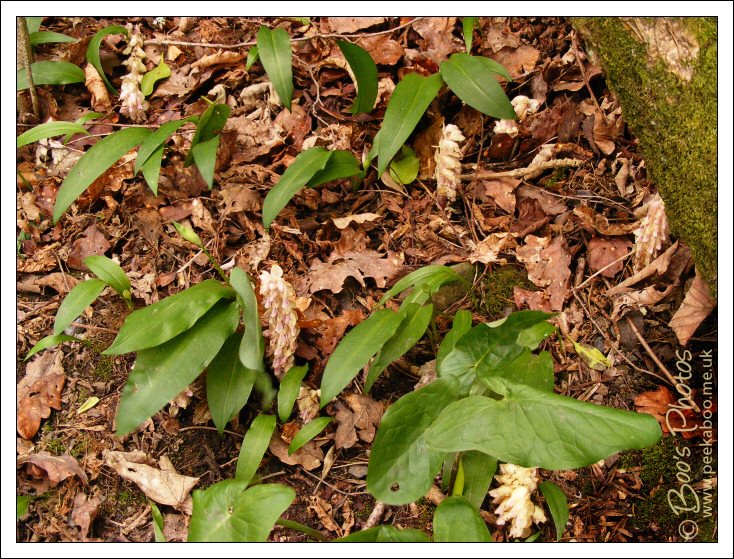
Can anyone identify this plant?

Whilst I don’t claim to be any sort of expert when it comes to nature, I have lived quite a while and do like to spend time outside, so I have accumulated some knowledge of the natural world. But on a recent walk, I spotted a flower that wasn’t at all familiar.

It had the look of an orchid, so I took a few photographs of it just to allow me to grab the nature book back at the car and find out what it was. I only had my compact camera with me as it was very cold, blowing a gale and I couldn’t be bothered man-handling the SLR that day. Due to the wind and it’s location under trees and adjacent to a wall, it was hard getting the shutter speed up fast enough to freeze it from moving in the breeze, so this is the best shot I got.

Please click on the photo to see a larger copy.

The leaves adjacent are not part of the plant, I think they’re garlic plants that were just in bud at the time. There was a patch of flower stalks like this just sticking out of the ground – about half a dozen, all seemingly with flowers appearing just on the one face. They’re a pinky-neutral colour and the best approximation I can make from my books is that it’s a Bird’s Nest Orchid.

Bird’s Nest Orchids are reported as being associated with close proximity to Beech or Yew trees, but from the leaves in the photos you can see the predominant trees in the area are oaks.

Please click on the photo to see a larger copy.

My books and the searching I’ve done seem to have turned up photos that are similar, but the Bird’s Nest Orchids seem to be all of a single colour (as they lack chlorophyll) without any sort of patterning and somewhat glutinous looking. These seem to have some variation in the colour, with pink tones, so I wonder if they’re actually something different?

The photographs were taken along the western shore of Windermere, just adjacent to the path along the lake between Red Nab and Wray Castle. It’s a busy and popular spot for walkers, cyclists and horse riders and the flowers were only inches from walkers, I was stood on the path when I took the photos.

4 May 2009

One of natures great engineers

We went out in the garden to do some work yesterday (see last blog) and as I stood on the doorstep I could hear a little noise – looking up there was a wasp working on her nest on the door frame. It’s a fabulous structure, but we couldn’t leave it there. I just managed to snatch a handful of photos before Mr Boo removed it. And yes, my door frame does desperately need painting.

This was my first view of the nest, pretty much in silhouette in the door frame.


It was a stunningly clever structure and I was loathe to break it off, but having seen how large (and how fast) one got in a friend’s garden last summer, decided we needed to be rid of it at this stage.

My reading would suggest that at this time of year, the larger than average wasp building the structure was probably a queen. It seems that all wasps except queens die off over winter and she survives having holed up somewhere safe in an old nest or new small one she makes just for the purpose. In late April/early May, the queen starts off making a small new nest in order to lay her eggs.

She was fertilised last year and lays her eggs in the new part-made nest and as they hatch, they continue with the structure in order to make a full size nest for the entire colony. The nests can grow up to 30cm (1′) in diameter or more and will likely be occupied all summer. Looks like we were right to destroy it before it took hold, she won’t have been alone for long.

She was very, very annoyed that we undid all her handiwork,
had it been in a better position, we might have left it to develop
and observe, but it really had to go from where it was.

She disappeared inside at one point and I was hoping to see what she
was
doing, but I was in a very precarious position with a heavy camera and
long lens in one hand and too close to focus, so ducking further
and
further back to try and focus, so it has a little movement blur.


Last summer I experienced the same little noise when out in the garden and it took me several days to identify it. That too was a wasp – on that occasion he was gathering his building materials rather than using them. He was working away on an old wooden garden chair, removing bits of timber in long thin strips, which he appeared to sheer off with his mouth parts and coil it up as he worked – when he’d got a decent sized piece, he’d fly off out of sight with it, only to return shortly and repeat the process. They apparently chew the wood up into a pulp with their saliva and this gives rise to a paper-type product for the structure of their nests.

Over a few days, he stripped the surface off a lot of my chair. If I went close to either observe or shoo him off, he’d just vanish round the back and continue working, thinking I didn’t know he was there, removing my garden furniture a few grams at a time. The little noise of timber being stripped being the only clue that he was still beavering away on the timber for his home.

In this frame, most of the timber surface has been removed, you can
see the exposed rough fibres and the odd remaining patches of varnished
surface where he’s ‘missed a bit’.
3 May 2009

It’s amazing what there is to see when you look closely

You can click any of the photos to see a larger version.

My very modest postage stamp of a garden has been a great joy to me since we developed it from scratch. It has filled out and developed over the years into a haven of peace – the place I reward myself with time when I reach some deadline or the end of an especially tricky piece of work. I potter and tinker as I eat my lunch and work outside on every day the weather makes it possible.

I laughingly call it my ‘courtyard garden’. In reality, it started life as a typical yard to a Lancashire cottage – a walled patch of concrete, originally to house the outside facilities – and in more recent times, the bins.

There is a tale attached to the layout of our house and outside areas, which are pretty much back to front. It would be normal practice for houses to face the street and have their back yards on the side of the house furthest from the street, but our house is one of a collection of cottages, all slightly different, that housed the workers of the adjacent mill. Mine, the largest and end of a short row, is reputed to be the mill manager’s cottage. My yard and back door are on the street side and my ‘front’ door on what is the gable end.

When they were built, the owner of ‘our’ mill was in some sort of feud with the owner of an adjacent mill, who owned a very large domestic property of some status (in recent times it has been a nursing home) along from the row of mill workers’ cottages. In order to cause him maximum offence, our mill owner built the properties back to front, to ensure that the outside facilities and less attractive aspect of the houses faced the road, so that as his rival drove past to his large luxurious home in his carriage, he had to pass the back of the workers’ homes, offending his sensibilities.

Our cottage is a long thin stone built property of about 140 years old now. So the yard is long and thin too. We have our proper garden on the other side of the house, but the layout doesn’t make it as suitable to occupy, so I leave that as my bird garden – one to be viewed from inside and enjoyed through windows and my courtyard garden is the one we spend time in. Being fully walled it gives us more privacy and is a sheltered sun trap that has allowed it to thrive.

Due to unfortunate domestic circumstances, I’m not going to be able to spend any money on summer planting this year, or at least only the barest minimum. So I decided today to make the best of what we already have.

I’ve always kept a lot of evergreen plants and perennial greenery to supplement annual flowers, which ensures that it looks good and has interest all year. Which will come into its own this season when I can’t do so much summer planting. So we moved things around to fill gaps and re-potted things and gave it a good tidy and I was pretty happy with the results.

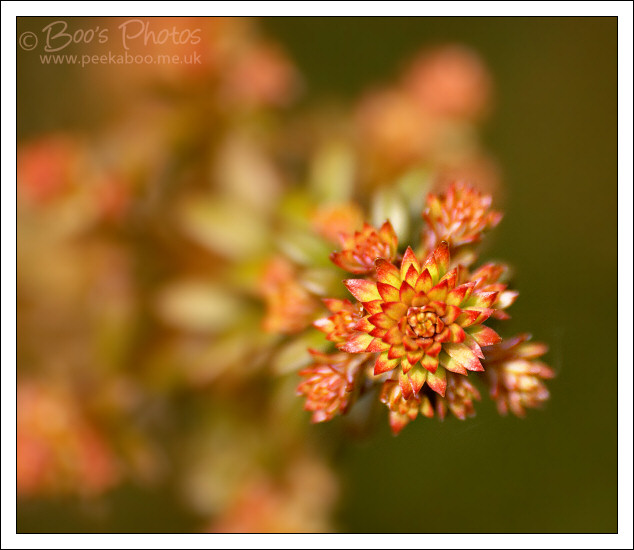
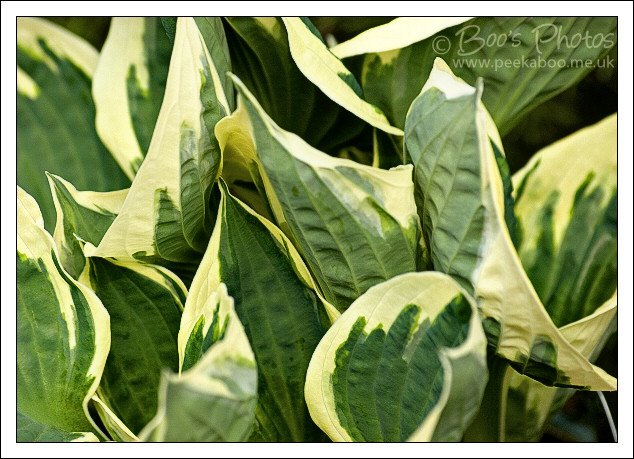
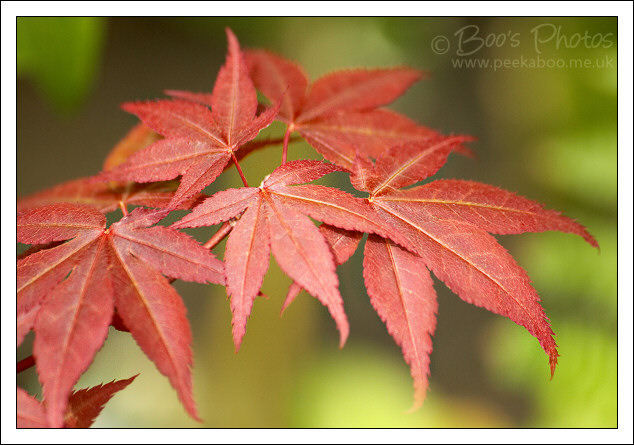
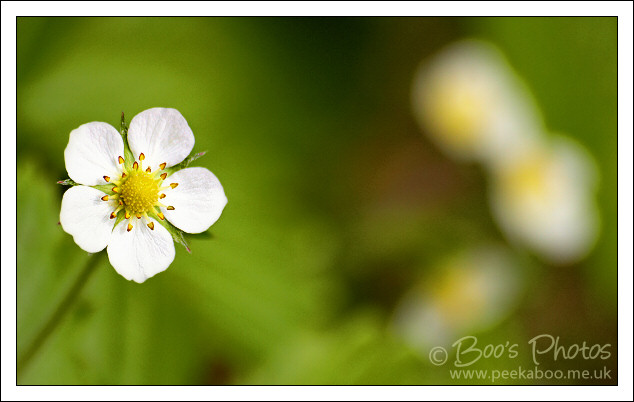
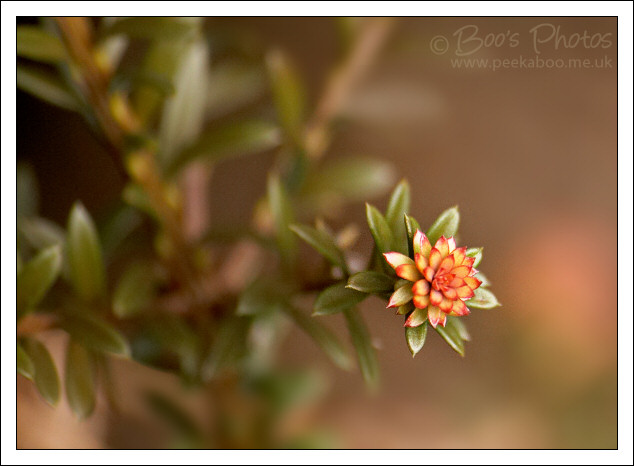
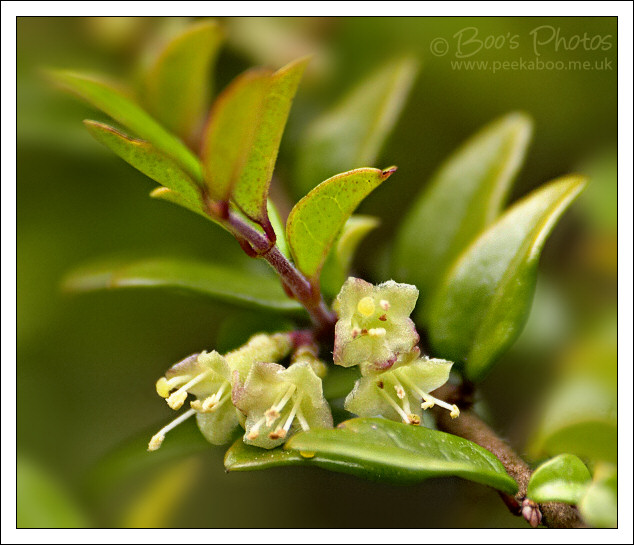
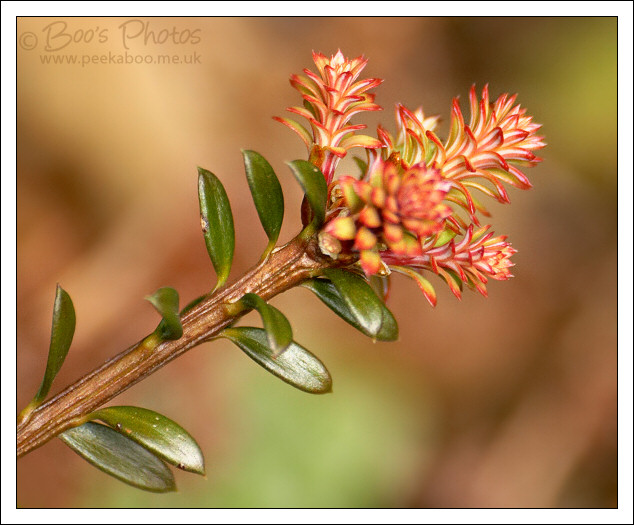
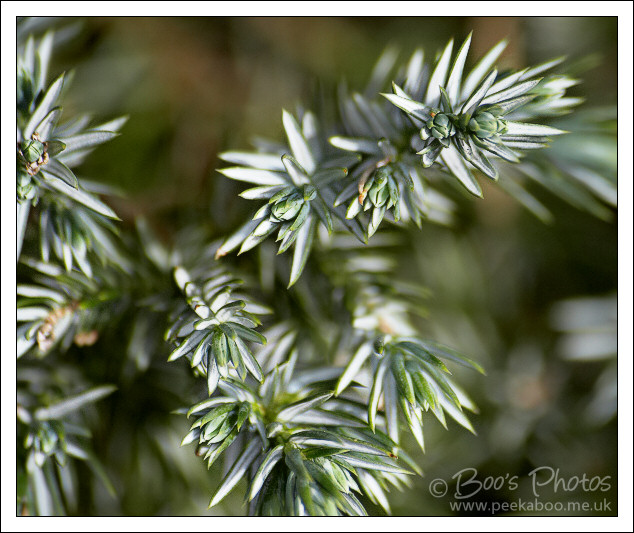
It’s at that exciting time when everything is waking up after winter and even supposedly ‘green’ shrubs develop little flowers and new growth races away. I took some photos – most of these below are of very small areas of growth, tiny little flowers at the end of shoots – some only a few millimeters in diameter. This is why I love taking photos of little things – you get to see detail that you just don’t see with the naked eye.

I was astonished to see that this little flower at the end of a growing shoot actually has striped petals on the back – why does nature bother to give it this detail?