26 May 2009

Things you don’t expect to see

Some days you head off out somewhere with no particular expectations, just out for a nice day, hopefully in decent weather and getting some fresh air.

And it’s usually one of those days when you see something unusual and unexpected. I’m not talking earth-shatteringly interesting or world-changing, just something that makes you smile, because it’s out of context, amusing or unusual.

Sunday of the Bank Holiday weekend was one such day. We had to run some errands in Warrington, so decided to head a little further on to the Delamere Forest – we’ve not been before, wanted some fresh air and it was a lovely, perfect, early summer day.

We don’t know the area and weren’t sure of the best car park to use for the walking etc., so basically parked at the first one we came to. There were a lot of people, as you’d expect for a nice Sunday, but the car park was generously sized and there was plenty of space. The one thing I hadn’t expected was the amount of horses and horse boxes. It’s obviously a place where horse owners bring their animals to exercise and trek along the extensive bridleways. There was a hive of horsey activity, horses being saddled, rubbed down, fed and watered. Big horses, little horses, brown horses and white horses. Horses with business men aboard, horses with toddlers, being walked slowly.

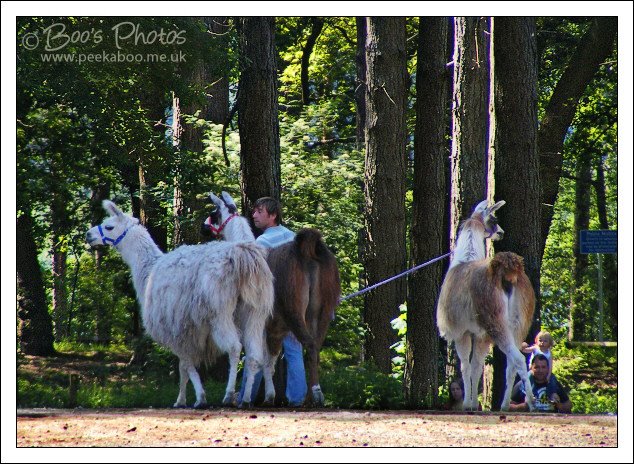
But in the middle of this was a horse style box – but it hadn’t transported horses – it had contained 3 llamas. Mr Boo couldn’t resist going over to see if he could pet them en route to pay for the parking. He found out all sorts of information about llamas – for example, these were being trained for trekking with parties of people – and got to pet one too – he was advised not to pet the adults as they tend to shove and jostle you – and they’re bigger than you think – but he got to tickle the youngster (far right) and stroke his furry lips. He didn’t shut up all day about it. Because he got to pet a llama and I didn’t. I did however pet one of the two three legged dogs we saw.

So I set off for some fresh air on Sunday, but really hadn’t expected to see llamas, on leads, being taken for a walk.

Please click the photo for a larger view.

I’d been slowed down by my cameras being locked in the car boot (new car, had to actually figure out how to unlock the boot first) and just managed to snag this shot as they headed into the trees and deep shadow – I’d taken it at an angle to try and get them all in, as I was fully zoomed, tight in between the rumps of two approaching horses.
17 May 2009

Squirrel with an identity crisis

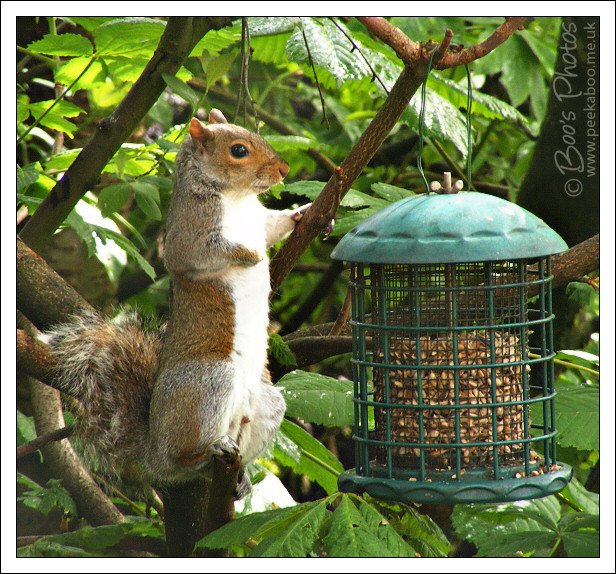
We were eating a somewhat late and leisurely breakfast yesterday, as is our habit at weekends and I spotted this chap out of the kitchen window.

We have a handful of grey squirrels that visit our bird feeders regularly and we put food for them in their own box too. He must have been having his own breakfast when something caught his eye – I suspect it was a neighbour’s cat, as later he went up a bit higher and was swearing quite profusely at her sitting in the garden beneath him.

Despite seeing squirrels daily, they don’t often stand upright in this manner in the trees. He’s obviously seen meerkats doing this and thought it was a pose with some observational value. I love how his left hand is holding on.

Click the photo to see a larger version.

I only had my small camera to hand at the time, set ready for some jewellery photos I was working on and the light was much darker under the trees than it looks, so it was zoomed to the max (380mm @ 35mm equivalent) and I could only manage 1/20 second – hand-held, that’s somewhat of a big ask for even my steady hands. I wish I’d manually dropped the exposure a little though and avoided blowing the white fur catching a patch of sunlight on his chest.

By the time I’d upped ISO, the moment had passed and he was back on with his breakfast. My very dirty windows didn’t help either, so the photo has had some work.

15 May 2009

Aluminium kitchen foil as a photographic tool

One corner of my workbench is allocated as my photography studio, specifically for jewellery photographs for my site and Etsy shop, so I don’t have much space to spare, so I have to work efficiently.

I’ve written two articles on how I take my jewellery photographs and this blog is a supplement to them. One on the general photographic techniques needed to get the best out of small item photography and how to overcome most of the technical pitfalls people encounter and the other specifically on the lighting set up I have adopted.

I struggled for a long while with getting my photographs how I wanted, I was very much over-complicating it, because I had good gear and I felt obligated to use it. But it was unwieldy and impractical and eventually I stripped it down to absolute basics with a small digicam with a good macro mode and immediately my images both looked better and my workflow was significantly quicker and more enjoyable. I’ve since bought a digicam with better features specifically for my jewellery photography, I’ll keep my DSLR for when that is the best tool for the job.

A finished frame after a little cropping and post-processing.

The lighting set up I use utilises a magnifier light I have on my work bench which has a ring fluorescent tube around a magnifier – I use it extensively for close work and it is clamped with an angle poise type frame to the end of my work bench. Whilst the light is certainly more diffuse than from a single spotlight bulb, it was still rather too harsh and unidirectional, so I made a lighting diffuser from a wild bird fat ball bucket which has two holes cut in it for camera access. I use the light on one side of it and I have the other side lined with scrunched aluminium kitchen foil. I have kept pieces of foil folded in my camera bag all my photographic life, it is an amazingly powerful yet simple tool to have in your arsenal – and can lift the light and brighten shadows more than you might expect.

When setting up some photographs today and was framing with the camera, I realised that I hadn’t put my diffuser back in place after setting up the scene and as I replaced it and was looking through the camera, I was surprised to see how much it really did change the scene, so I took two photos to illustrate the difference.

This is the scene without the diffuser in place, there are
deep shadows behind the driftwood and the scene would
need more exposure for a better result. My camera was already
set in anticipation of using the diffuser, so you can clearly see how
much advantage it offers as this image would be much too dark.
I guess that the advantage is about two thirds of a stop.

Both photographs were taken with the same, manually set, camera exposure and with the camera, light and scene exactly the same – each file was prepared to post with exactly the same workflow and settings. The only thing that changed was the placing in position of my ‘bucket’ diffuser. The light has been diffused by the translucent material on the right side where the light was positioned and the opposite/left side has been lifted by the light reflected back into the scene with my scrunched aluminium stuck on the inside of the bucket, opposite the light source.

As you can see, the lighting level generally has lifted noticeably
and the deep shadows to the left of the driftwood have been
softened considerably. A bit of remaining shadow is good as it
shows more form to your pieces – diffusing the lighting too much would
actually give rise to rather flat lifeless results.

So if you’re struggling with not having enough light on your scene, or deep shadows from unidirectional lighting, try scrunching some kitchen foil and then smoothing out and sticking it on some card – you can then move it around to see where you get most advantage. Using foil flat – or a mirror – will result in brighter spots of light and maybe reflections. Scrunching the foil to make it creased, then flattening it out causes it to scatter the light more evenly and will lift the lighting level generally without high spots or reflections.


The top of this pair of shots was taken with my foil reflector and the light only, no diffuser in this instance – I was curious to see just how much difference to the lighting the reflector alone made.

I took the first frame and all I did with the second image was swing my left hand holding the reflector out of the way and take a second frame – at the same manually-set exposure – just to show how much light a small piece of kitchen foil can add to the scene – in this case, about two thirds of a stop. The top one is still a smidge under-exposed and if I wanted to use this frame, I’d tweak its appearance, including correcting the colour, a little in post-processing, but the exercise was just to illustrate the difference to the overall lighting levels in the scene and the general distribution of the light and lifting of shadows, just with the addition of some reflected light.

This is the finished frame I’ll use, from another frame taken with a slightly better exposure and the diffuser in place too.

13 May 2009

250th item added to my shop!

When I first started selling my jewellery on-line, I went through a slow and agonising process trying to decide on how best to present items for sale – I started with buying a domain name in some hosting with the full intention of starting my own shop – initially using PayPal buttons to create a pseudo cart. I had sold greetings cards for a long time using this process and it had worked well, but the jewellery didn’t quite work as well – I needed more than one photo per item and much more space for measurements, descriptions etc.


I did a lot of work putting pages together and trying layouts and organisation and it became clear very early on that this was going to be a very tedious process. I seriously needed to hone the workflow into something actually manageable. It takes a lot of work to photograph jewellery pieces, measure them, write a description and price them – often this part takes longer than it does to make the item. To then have to write code to put them on a web page and keep the site organised, took it beyond practicability – on top of a day job and time spent making too – which is the fun bit and consequently likely to suffer.

I’d bookmarked and been looking at the US based hand made venue site Etsy for some time, but hadn’t realised that as a UK crafter I could also have a shop there, so putting some items on there gave me the chance to embed my Etsy mini shop (as seen here in brief form on the right) onto a basic portfolio page on my site and bought me some thinking time.


I’d visited and greatly admired an Australian jewellery store on-line. Their jewellery was elegant and expensive and their site gave just the right impression and worked really well – just what I had in my fantasy mind for my own – a page for each item, with multiple photos and nice easy navigation. I looked at the little credits at the bottom of the page and it said it was a Cubecart site.

Further investigation revealed that at the time there were three main cart systems of that style available largely free to use in the right web hosting packages – CubeCart, Zen Cart and OS Commerce. So I spent a great deal of time trying to find a host with them to try and I did try all three. CubeCart was head and shoulders above the others for me. At the time, it was the only one that allowed multiple photos per item and its methodology suited my requirements and skills by far the best.

I found that I could tweak the appearance myself by editing the standard graphics and editing the style sheets and thereby creating my own skin, based on one of the standard ones – this was a task within my capabilities. It also became evident that carts of this nature are highly customisable – there are a massive array of commercial skins and ‘mods’ to get them working how you want. It also became evident that the original Australian site that set me on this path was very heavily modded and I wasn’t going to get something quite so elegant within my skill-set and budget.

I fully intended to buy a commercial skin once I’d satisfied myself that this particular cart was the right one for me – I needed to be sure I was making the right decision before I invested even more work. I chose a skin, but spent some time modding my own from one of the three that come with the cart as standard. I wanted to add some items to see how it worked in practice. I put together a finished enough looking site and asked a few friends and family to test it for me, showing them the final design I was aiming for. Every single one of them preferred the working site appearance to the skin I had picked out, so I just stuck with what I had and spent the time polishing that up some more instead.


So that was about 15 months ago now. I’ve gradually modded the site to get it functioning more how I want it and I still have a lot more ideas to put into practice as the budget will allow. I find the site easy to work with – it might not be as good for other products or other methodology, but I have been thrilled with how it works for me. I suspect if I were significantly busier and had more staff, it might not be the best, but for me and my workflow, it has been absolutely ideal.

I now maintain both my own shop and a sister one on Etsy as separate entities – I’ve finally honed a workflow to allow me to use a lot of the same process for both shops and feel comfortable at last with how I’m working – I don’t think I can strip it to much greater efficiency and maintain the same high standards – that simply takes effort.

Yesterday I added the 250th item in my own shop, the copper and amethyst necklace shown above. There aren’t 250 items actually for sale, so it’s a tad misleading, some items are upgrades and buying options and 48 unique pieces have been left on the site but moved to a sold section, but it felt a significant milestone to see 250 ‘products’ in the shop. When I was tearing my hair out trying to figure out how best to offer my pieces for sale, this milestone was the stuff of pure fantasy. I’m glad I stuck with it, the results now are what I hoped for, but I wish the journey hadn’t been quite so agonising!